Mic Check, 2024: Why Gen Z Is Making Spoken Word the Hottest Room in the House
There's something happening in the back rooms of coffee shops, on the mainstages of festivals like Lollapalooza's literary annexes, and in thirty-second vertical videos that loop at 2 a.m. — something raw, something electric, something that feels almost rebellious in a world where content is curated, filtered, and optimized to death. Spoken word poetry is back, baby, and Gen Z didn't just show up to the party. They threw it.
In 2024, slam poetry events across the US are reporting attendance surges that would make venue owners weep with joy. According to data compiled by the Poetry Foundation, live poetry events saw a 34% uptick in ticket sales between 2022 and 2024, with the steepest growth concentrated among audiences aged 18 to 27. Platforms like Button Poetry — the YouTube channel that turned poets like Sarah Kay and Phil Kaye into household names — are pulling millions of views per month. And on TikTok? The hashtag #spokenword has cracked 2 billion views and counting.
So what's driving this? Why are young people who grew up on Instagram Reels and Spotify playlists suddenly packing into dimly lit rooms to watch someone stand at a microphone and bleed?
The Anti-Algorithm Antidote
Here's the thing about the internet in 2024: it knows you too well. Every scroll is a mirror. Every recommended video is a reflection of what you already believe, already love, already are. It's comfortable — and it's suffocating.
Spoken word offers something the feed simply cannot: surprise. Unpredictability. A human being standing in front of you with no filter, no edit button, no second take. "There's a reason people cry at slams," says Deja Okafor, a 23-year-old Chicago-based poet who built her following on TikTok before transitioning to touring the Midwest open mic circuit. "It's because nobody told that poem what to be. Nobody A/B tested it. It just is."
Okafor's TikTok account, where she posts raw, single-take performances from her bedroom, has amassed over 400,000 followers. But she's quick to point out that her online audience and her live audience feed each other. "TikTok gets people curious. The venue gets them hooked."
This dual ecosystem — social media as discovery engine, live performance as conversion — is redefining how spoken word artists build careers. It's less about landing a book deal and more about building a community that will follow you from the screen to the stage.
Slam Culture Gets a Glow-Up
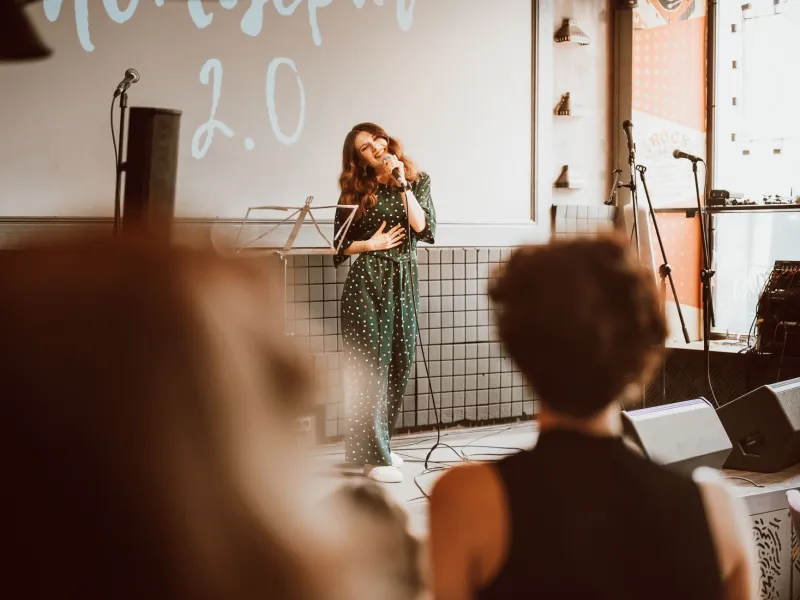
If you picture slam poetry and still see a basement open mic with a battered notebook and a two-drink minimum, it's time to update your mental image. The new wave of spoken word is glamorous, intentional, and deeply intersectional.
Events like Get Lit's Classic Slam in Los Angeles and the Louder Than a Bomb festival in Chicago have evolved into full-scale cultural productions — think curated lineups, professional lighting, merchandise tables, and post-show DJ sets. Youth slam organizations are reporting record-breaking participation numbers. Louder Than a Bomb, which centers high school-aged poets, registered over 1,000 student participants in its most recent season. That's not a niche art form. That's a movement.
"We stopped calling it 'just poetry,'" says Marcus Webb, a performance coach and slam organizer based in Atlanta. "We call it what it is — live literary entertainment. And when you frame it that way, people get it. People want in."
Webb has watched Gen Z poets arrive at open mics with a professionalism that older generations had to learn the hard way. They understand branding. They understand audience. They understand that the poem on the page and the poem on the stage are two completely different animals.
TikTok's Stage Is Bigger Than Madison Square Garden
Let's talk about the numbers for a second, because they're staggering. Poets like Rudy Francisco, who have been doing this for decades, are experiencing second winds thanks to short-form video. Meanwhile, entirely new voices — queer poets, disabled poets, poets of color who might never have gotten a booking agent's attention — are amassing audiences in the hundreds of thousands simply by pointing a phone at their face and speaking truth.
"TikTok democratized the stage in a way nothing else has," says Priya Suresh, a 21-year-old South Asian American poet from New Jersey whose meditation on identity and immigration went viral last spring with 6 million views. "I didn't have to audition for anyone. I didn't have to know the right people. I just had to be honest."
That accessibility is arguably the most radical thing about the current spoken word renaissance. The gatekeepers — publishers, bookers, literary journal editors — still exist, but they're no longer the only door in the building. A poem can go from a Notes app draft to a viral video to a festival booking in the span of a few months. And increasingly, that's exactly what's happening.
What This Means for Live Performance
The surge in spoken word's popularity isn't happening in a vacuum. It's part of a broader cultural hunger for live, embodied experience that accelerated in the aftermath of the pandemic. People spent years consuming art through screens. Now they want to feel it — in a room, with strangers, in real time.
Venue owners are paying attention. Independent bookstores like The Strand in New York and City Lights in San Francisco have expanded their event programming to include regular poetry nights. Festivals like SXSW have grown their literary and spoken word tracks significantly. Even comedy clubs are experimenting with hybrid poetry-comedy lineups, recognizing that the overlap between the two audiences is larger than anyone expected.
For Gen Z, spoken word isn't a nostalgia trip or a retro curiosity. It's the most honest art form available to them — one that requires nothing but a voice, a story, and the courage to stand still long enough to say something real.
The mic is open. The room is full. And the glitter? It's absolutely everywhere.