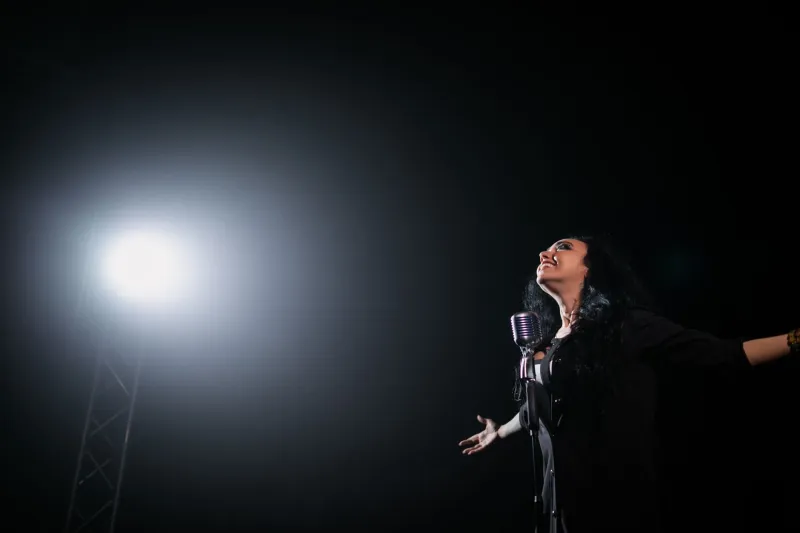
Your Words Deserve a Spotlight: The Writer's Playbook for Owning the Stage
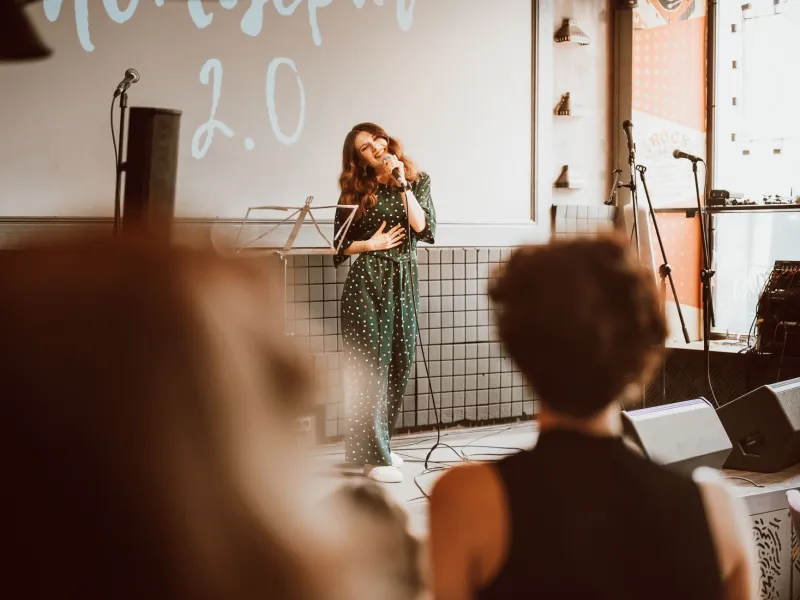
Writing is an act of solitude. Performance is an act of communion. And somewhere between the quiet of your desk and the chaos of a live audience, your words have to make a journey that most writers completely underestimate.
Here's the truth nobody tells you at your MFA program or in the comments section of your Substack: a great piece of writing does not automatically become a great performance. The two crafts are related — deeply so — but they are not the same. The page forgives. The stage does not. But with the right preparation, the stage also rewards you in ways the page simply cannot match.
This is your playbook. Let's build your show.
First, Understand the Translation Problem
When a reader encounters your work on the page, they bring their own internal voice to it. They set the pace. They pause when they need to. They re-read the lines that hit hardest. They are, in a very real sense, co-creating the experience.
A live audience doesn't get any of that. They're locked into your pace, your interpretation, your presence. Which means every choice you make — every breath, every pause, every shift in volume — is doing work that punctuation and white space used to do for you.
"Writers come to me thinking performance is just reading out loud with more confidence," says Tanya Rollins, a New York-based performance coach who has worked with everyone from debut novelists to Instagram poets preparing for their first major festival appearances. "I have to gently dismantle that. Performance is a completely separate skill set. It's physical. It's spatial. It requires you to be in your body in a way that writing absolutely does not."
The good news? That skill set is learnable. Every single part of it.
Step One: Edit for the Ear, Not the Eye
Before you step within ten feet of a microphone, sit down with your written work and read it aloud — alone, in a room, without an audience. Every piece of writing sounds different spoken than it reads on the page. Long, complex sentences that are elegant in print can become verbal obstacle courses when performed. Semicolons are invisible to listeners. Parenthetical asides can lose an audience mid-thought.
Mark up your script the way a musician marks up sheet music. Note where you naturally breathe. Circle words that feel awkward in your mouth. Identify the emotional peaks — the lines where something shifts — and make sure they're structurally positioned to land with impact.
Consider creating a performance draft that's distinct from your published version. This isn't cheating. It's craft. Author Ocean Vuong, whose poetry collections have earned him a devoted literary following, is known for performing versions of his poems that breathe differently than the printed text — longer pauses, altered line emphasis, occasional improvisational additions. The poem on the page is the blueprint. The performance is the building.
Step Two: Build Your Vocal Toolkit
Your voice is your instrument. Treat it like one.
Rollins recommends a simple but transformative exercise she calls "the dial." Imagine your vocal energy exists on a scale from one to ten. Read through your piece at a five — your natural conversational register. Then identify moments that call for a three (intimate, almost whispered) and moments that demand a nine (full projection, emotional intensity). Map those shifts onto your script.
"Monotone kills performances," she says flatly. "Not because the writer isn't talented, but because the audience's nervous system needs variation to stay engaged. Dynamic range isn't drama — it's biology."
Practice pacing deliberately. Most writers, when nervous, speed up. Slow down instead. Silence is not dead air — it's punctuation. A two-second pause after a powerful line gives the audience time to feel it before you move on. Rupi Kaur, whose minimalist Instagram poetry translated into sold-out worldwide tours, has spoken extensively about learning to let her pauses do as much work as her words.
Step Three: Make Friends With Your Body
Stage fright is real. So is the temptation to hunch over a lectern and stare at your notes like they contain the answers to a final exam. Resist it.
Your physical presence — where you stand, how you hold yourself, what you do with your hands — communicates as much as your words. A performer who stands still and grounded reads as confident and intentional. A performer who sways, paces nervously, or breaks eye contact reads as uncertain, and uncertainty is contagious.
Start with your feet. Plant them. Shoulder-width apart, weight balanced. This single adjustment changes everything about how you're perceived and, crucially, how you feel. From that grounded position, your hands can move naturally. Your head can lift. Your eyes can find the audience.
Eye contact is the secret weapon of live performance. You don't have to stare anyone down — that's uncomfortable for everyone. Instead, let your gaze travel across the room in slow, deliberate arcs, landing briefly on different sections of the audience. This creates the sensation, for everyone in the room, that you're speaking directly to them.
Step Four: Know Your Opening and Closing Cold
Memorize the first thirty seconds and the last thirty seconds of your performance. Not because you need to memorize everything — reading from a script or notes is completely acceptable and widely practiced — but because your opening and closing are where you make and seal your impression.
A strong, confident opening signals to the audience that they're in good hands. A clean, deliberate closing (no trailing off, no "um, yeah, that's it") leaves them with the emotional resonance you worked so hard to create.
Author Rebecca Solnit, who has done extensive public speaking alongside her literary career, has described the closing of a live reading as "the last gift you give the room." Make it count.
Step Five: Perform Before You Perform
Don't let your first audience be a real audience. Run your piece for friends, family, a camera, a mirror — anything that forces you to commit to the performance rather than rehearsing it in your head. Video yourself and watch it back. Yes, it's uncomfortable. Do it anyway. The gap between how you think you're coming across and how you're actually coming across is usually significant, and video is the fastest way to close it.
If you can, find an open mic or low-stakes reading series to workshop the material before a bigger event. Open mics are generous spaces — audiences at them are rooting for you by default. Use that goodwill as a laboratory.
The Payoff Is Real
When it works — when the room goes quiet in exactly the right moment, when a stranger catches your eye and nods, when applause breaks before you've even finished your last line — there is nothing quite like it. The page is permanent. The stage is alive. And your words, given a voice and a body and a room full of people willing to listen, become something neither you nor your audience will forget anytime soon.
The spotlight is waiting. Step into it.