When the Sparkle Kills the Story: How Overproduced Lit Events Are Losing Ground to Raw, Unfiltered Rooms

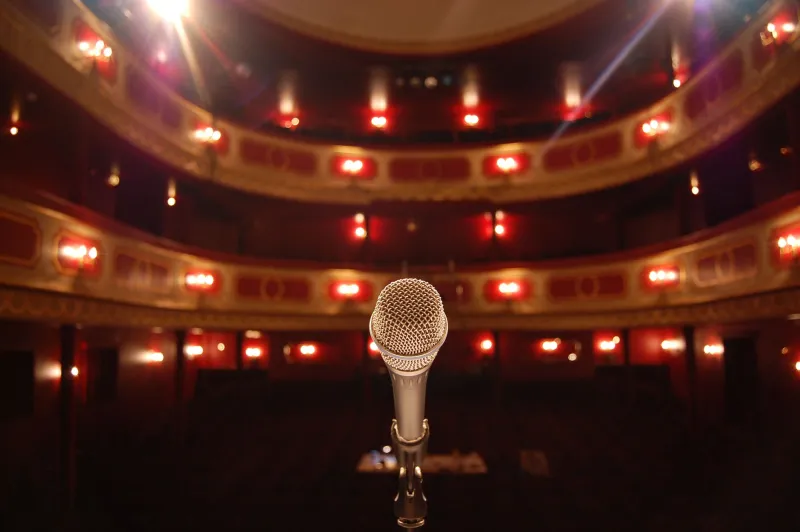
There's a specific kind of disappointment that hits when you walk into a spoken word event and realize it looks more like a product launch than a poetry reading. The fog rolling across the stage floor. The branded backdrop. The sponsor logos cycling on screens flanking a podium that cost more than most poets make in a year. You paid forty-five dollars for this. You dressed up. You were ready to feel something. And instead, you feel like you're at a trade show for feelings.
This is the glitter trap — and a surprising number of live literary events have stumbled right into it.
The Production Arms Race Nobody Asked For
Over the past several years, as live lit carved out a legitimate corner of the entertainment economy, event producers started borrowing playbooks from music festivals and corporate keynote events. Better lighting. Bigger venues. Slicker branding. On paper, it made sense. If spoken word was going to compete for discretionary entertainment dollars, it needed to look like it belonged in that conversation.
But something got lost in the translation.
"There's a difference between production that serves the work and production that replaces it," says Maya Tillson, who books talent for a mid-sized literary series in Philadelphia. "When the lights are doing more emotional work than the poet, you've got a problem."
The audiences noticed before the producers did. Ticket sales at several high-production spoken word events in major markets — New York, Chicago, Los Angeles — started softening right around the time the events themselves started looking increasingly indistinguishable from TED Talks with better playlists. Meanwhile, the waiting lists for intimate, no-frills reading series in the same cities kept growing.
What Audiences Are Actually Buying
Here's the thing about spoken word that makes it fundamentally different from, say, a pop concert: the entire value proposition is human proximity. People show up because they want to be in the room with another person who is saying something true. The electricity of live literary performance runs on vulnerability, and vulnerability doesn't scale well with a forty-foot projection screen behind it.
A 2023 audience survey conducted by a Brooklyn-based literary nonprofit found that the top two reasons attendees cited for returning to a spoken word series were "feeling close to the performer" and "feeling like the space was made for people like me." Production value didn't crack the top five. Free parking did, but that's a whole other conversation.
The audiences crowding into underground rooms aren't doing it because they can't afford the polished events. They're doing it because the polished events stopped making them feel anything. There's a meaningful difference between those two things, and smart producers are finally starting to pay attention to it.
The Venues Getting It Right
In Austin, a reading series called Honest Ground has been running out of a converted auto shop for three years. No stage lighting beyond what was already in the building. Folding chairs. A single microphone on a stand. Average attendance: sold out, every single time, with a waitlist that regularly hits two hundred names.
The organizer, Dre Castillo, is deliberate about what she won't add. "People keep offering to sponsor us, and I keep saying no," she told us over the phone. "The moment we put someone's logo in that room, the room stops being theirs. And it's their room. That's the whole point."
In Portland, a queer literary collective called Soft Riot runs quarterly events in a back room of a record store. The vibe is intentionally unpolished — mismatched chairs, handwritten set lists taped to the wall, performers who introduce themselves by their neighborhood instead of their publication credits. Tickets are fifteen dollars, sliding scale. They routinely outperform larger, better-funded events in the same city on every metric that actually matters: audience retention, word-of-mouth growth, and artist satisfaction scores.
These aren't outliers. They're a pattern.
The Counterintuitive Economics
Here's where it gets interesting for anyone who thinks about the business side of live entertainment. Stripped-down events are not just artistically healthier — they're frequently more profitable per attendee than their overproduced counterparts.
When you remove the lighting rig rental, the AV crew, the branded backdrop, and the event photographer shooting content for a sponsor's Instagram, your overhead drops dramatically. A fifty-person room at fifteen dollars a head, with minimal overhead, can generate a healthier margin than a three-hundred-person event at forty dollars a ticket with a production budget that eats most of the revenue before a single poet gets paid.
And the poets getting paid part matters. One of the most consistent criticisms leveled at high-production lit events is that the money goes into the spectacle rather than the artists. Underground rooms, by contrast, tend to be more transparent about where ticket revenue goes — and more likely to actually pay performers a living rate for their work.
"I've performed at events with full production budgets where I got fifty dollars and a drink ticket," says Chicago poet and essayist Simone Brauer. "I've also performed in someone's living room and walked out with two hundred dollars and a home-cooked meal. The math isn't complicated."
The Trust Problem at the Heart of It
Underneath the aesthetics and the economics, what's really happening here is a trust problem. Spoken word audiences are perceptive. They can tell when an event is designed to make them feel something versus when it's designed to make them spend money. And when those two things start to feel like the same thing, the audience walks.
The underground rooms winning right now aren't winning because they're cheap or because they're anti-establishment for the sake of it. They're winning because they've preserved the fundamental promise of live literary performance: that what happens in this room, tonight, between these people, is real. That it couldn't have been pre-packaged. That it won't look the same next week.
Glitter, as it turns out, is most effective when it's earned — when it reflects something that was already shining before anyone pointed a light at it. The events that understand that are building communities. The ones that don't are building Instagram grids that nobody's saving.
What This Means Going Forward
If you're producing live lit events, the lesson here isn't "spend nothing." It's "spend intentionally." Good sound matters. Sightlines matter. Making sure the performer can actually be seen and heard is not optional. But the question worth asking before every production decision is: does this serve the story, or does it serve the brand?
And if you're an audience member who's felt that vague disappointment walking out of a forty-dollar spoken word event wondering why you didn't feel anything — you're not alone, and you're not wrong. Your instincts are good. The room that makes you feel something real is out there. It probably doesn't have a step-and-repeat. It probably has mismatched chairs. And it is absolutely worth finding.