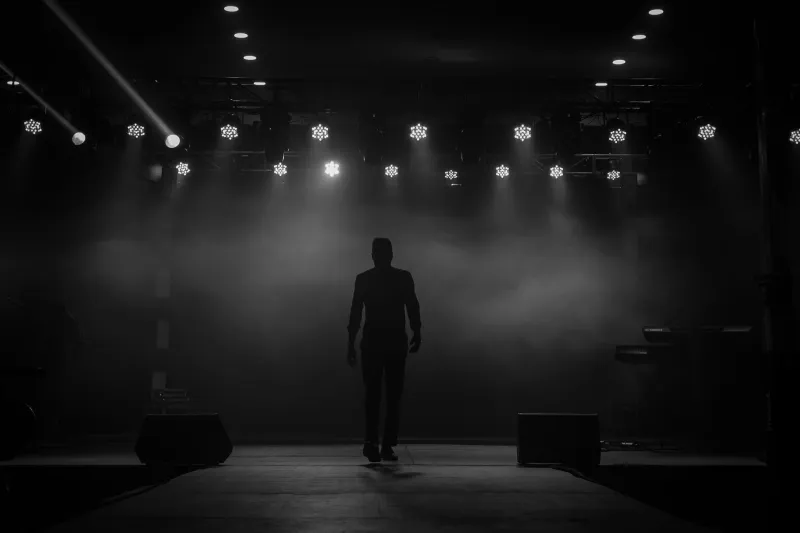
Hold the Beat: How Mastering Silence Turns a Good Performance Into an Unforgettable One

There's a moment that every seasoned spoken word performer knows intimately. You've just landed a line that cuts—really cuts—and the room goes still. Not the restless, distracted quiet of an audience waiting for something better. The held quiet. The kind where you can feel two hundred people breathing at the same rate. That moment doesn't happen by accident. It's engineered, beat by beat, breath by breath, through one of the most underrated skills in live literary performance: pacing.
And yet, walk into any open mic night from Brooklyn to Burbank and you'll watch performer after performer sprint through their material like they're afraid the words might expire. Rushing is the single most common mistake newer performers make—and it costs them everything.
Why Speed Is the Enemy of Impact
Here's the thing nobody tells you when you're starting out: the audience doesn't experience your poem or story the way you do. You've read it a hundred times. You know what's coming. To you, the buildup feels slow. To the room? It's the whole journey.
When you rush, you rob your audience of the chance to actually feel what you're saying. The emotional resonance of a line depends on the listener having just enough time to absorb the image, the metaphor, the weight of the thing—before you move on. Speed collapses that window. You end up delivering a technically perfect performance to a room that's perpetually three lines behind you.
Veteran performer and touring spoken word artist Deja Malone, who has headlined festivals from the Nuyorican Poets Cafe to the Moth's GrandSLAM in Chicago, puts it plainly: "The pause is not dead air. The pause is where the audience catches up and catches on. If I never give them that, I'm performing for myself."
She's right. And the financial reality backs her up. Performers who command premium ticket prices—the ones selling out 200-seat venues and landing repeat bookings—are almost universally the ones who've learned to trust the silence.
Breath as Architecture
Pacing isn't just about slowing down. That's a reductive take that leads to monotonous, plodding sets. Real pacing is about variation—the strategic interplay of speed, slowness, volume, and silence that gives a performance its shape.
Think of it like music. A song that stays at the same tempo and dynamic level for four minutes is exhausting to listen to, even if every individual note is technically correct. Great performers treat breath the way great composers treat rests: as load-bearing structural elements, not empty space to be minimized.
Marcus Ellery, a literary theater director based in Atlanta who has coached performers for over fifteen years, describes his foundational exercise this way: "I tell everyone I work with to find the three most important words in their piece. Not lines—words. And then I tell them to put a full breath before each one. Just one breath. That's it. And suddenly the whole thing opens up."
That technique sounds almost embarrassingly simple. But watch what it does in practice. The breath signals to the audience that something significant is coming. It creates anticipation. And anticipation, in a live performance context, is the closest thing to magic that craft can manufacture.
The Technical Side of Silence
For performers ready to move beyond instinct and into intentional craft, pacing has a few concrete components worth studying:
Rhythmic anchoring. Every piece has a natural pulse—a cadence built into the syntax and line breaks. Finding that pulse and committing to it, rather than fighting it in a rush to get to the next section, is the foundation of controlled pacing. Record yourself and listen back. You'll hear immediately where you're accelerating out of anxiety.
Dynamic contrast. If everything is loud and urgent, nothing is. The moments you want to land hardest need contrast to work. Pull back before you push forward. Whisper before you declare. The quiet sections don't slow your set down—they make the big moments hit harder.
The intentional pause. This is different from hesitation. A hesitation reads as uncertainty. An intentional pause reads as confidence—as someone who is so in command of the room that they can afford to let it sit in silence. The difference is posture, eye contact, and breath. Hold your body still. Breathe. Look at the room. Then continue.
Audience calibration. The best performers are constantly reading the room and adjusting in real time. If a laugh runs long, they wait it out instead of talking over it. If a moment lands in heavy silence, they let it breathe before moving on. This is live performance, not a recording—the audience is part of the instrument.
What Rushing Is Really About
Let's be honest about where the speed actually comes from. Most newer performers rush because they're scared. Stage fright compresses time. When your adrenaline is spiking, a two-second pause feels like an eternity. The silence feels like failure. So you fill it.
But here's the reframe: the audience isn't experiencing your pause as empty. They're experiencing it as weight. They're sitting with what you just said. They're feeling it. The silence isn't a gap in your performance—it's the performance working.
Deja Malone remembers the exact open mic where she learned this. "I dropped a line I'd worked on for weeks, and then I panicked and rushed straight into the next stanza. After the show, someone came up to me and said, 'That one line in the middle—I didn't catch what came after it because I was still thinking about that line.' That was the moment I understood. I was the one getting in my own way."
Putting It Into Practice
If you're actively working on your pacing, here's where to start:
- Record every rehearsal. Not just the final run-throughs. Record the messy ones. Listen for where you accelerate and ask yourself why.
- Mark your pauses in the text. Literally annotate your script with breath marks and pause indicators, the way a musician marks a score. Make the silence intentional before it becomes instinctive.
- Practice performing slower than feels comfortable. Then slower than that. You'll almost certainly land closer to the right speed than you think.
- Perform for one person before you perform for a room. A single audience member will give you immediate feedback on whether a pause is working or whether it's just awkward. Tune your instincts in intimate settings before scaling up.
- Study performers you admire—but watch for the pauses, not the words. Where do they breathe? What do they let sit? That's the real masterclass.
The Stage Rewards the Patient
The live literary world is having a moment right now. Audiences are showing up, paying real money, and hungry for connection. But connection doesn't happen at breakneck speed. It happens in the space between words—in the breath you take before the line that matters, in the silence you hold long enough to let a feeling crystallize in a stranger's chest.
The performers who are filling rooms and building loyal audiences aren't necessarily the ones with the flashiest material. They're the ones who've learned to trust the pause. To hold the beat. To let the silence do the work that no word ever could.
Your words are good enough. Give them room to land.