The Cost of Bleeding Out Loud: How Spoken Word's Vulnerability Culture Is Breaking the Artists Who Built It
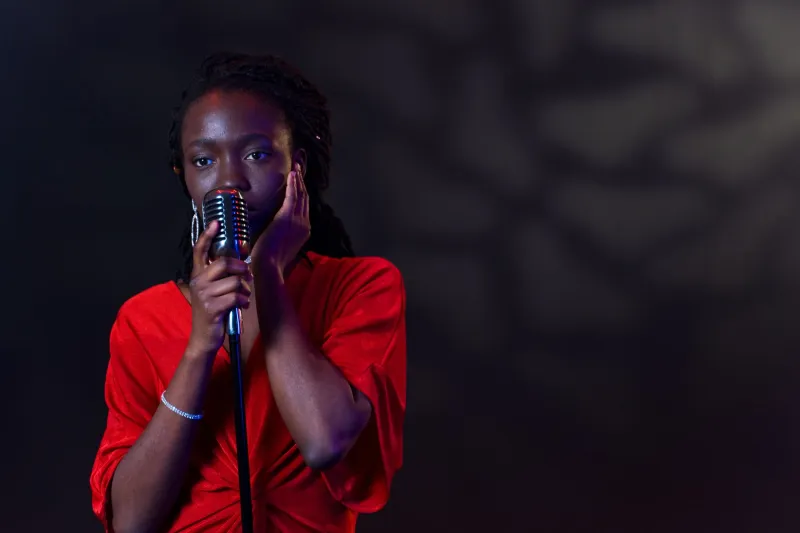
There's a moment every spoken word artist knows. The lights come up, the room goes quiet, and you reach into the deepest, most tender part of yourself and pull something out for strangers to witness. It's electric. It's terrifying. And for a growing number of performers across the country, it's becoming unsustainable.
Spoken word built its entire identity on emotional honesty. That's the art form's superpower — the reason a good poem can make a packed room in Brooklyn or Atlanta hold its breath at the same time. But in 2024, with viral clips driving ticket sales and audiences arriving hungry for catharsis, the pressure to go deeper, get rawer, and share more has quietly crossed a line. What started as artistic courage is, for some performers, starting to look a lot like self-harm with a spotlight on it.
When "Authentic" Becomes a Performance Standard
Dr. Renata Osei, a licensed clinical psychologist based in Chicago who works with creative professionals, puts it plainly: "The problem isn't vulnerability itself — vulnerability is healthy and connective. The problem is when vulnerability becomes a demand. When artists feel they have to perform their worst moments on command, for audiences who've paid to feel something, that's a completely different psychological situation."
She describes what she calls "emotional extraction" — the repeated act of revisiting traumatic memories not as part of a healing process, but as a product. "Every time you go back to that wound to perform it, you're not necessarily processing it. You might actually be reinforcing the trauma response. And when the applause stops and the room empties, you're left holding all of it."
The numbers aren't tracked formally, but anecdotally, the burnout is real. Artists are quietly stepping back from the circuit, going dark on social media, and in some cases, walking away from the art form entirely.
The Viral Trap Nobody Warned You About
Social media has supercharged the problem in ways that didn't exist even five years ago. A poem about addiction, assault, or grief can rack up millions of views overnight — and suddenly an artist who shared something deeply personal in a small room finds themselves fielding booking requests from promoters who want that poem, that energy, at every show.
Jasmine Trevino, a spoken word artist based in Houston who has been performing for over a decade, knows this cycle intimately. "I had a piece go semi-viral — maybe 800,000 views — and it was about my mother's death. Suddenly I was getting booked specifically because of that poem. Promoters would literally say, 'Can you do the mom piece?' And for a while I did it, because I needed the income. But I was performing my grief on repeat like it was a cover song."
She pauses. "I had a breakdown after a show in Austin. Not a dramatic one. Just... I sat in my rental car for two hours and couldn't move. That's when I knew something had to change."
Trevino now has what she calls a "do not perform" list — pieces she's retired from her live set, not because she's ashamed of them, but because they belong to a version of her that needed to say those things once, not hundreds of times.
The Difference Between Catharsis and Excavation
Dr. Marcus Webb, a therapist and performance studies scholar at a university in the Pacific Northwest, draws a critical distinction that more artists need to hear. "Catharsis is a release," he says. "You process something through expression and you feel lighter. Excavation is different — you're digging into the same site over and over, and eventually you're not finding anything new. You're just disturbing old ground."
He argues that the spoken word community has conflated the two, and that audiences — however well-meaning — are often complicit. "Audiences want to feel moved. They want to witness something real. And there's nothing wrong with that. But there's a difference between an artist sharing a truth and an artist being pressured to perform their pain as entertainment. The audience can't always see that line, and neither can the artist, until it's too late."
What Veteran Artists Are Actually Doing Differently
The performers who've managed to build long careers in this space have largely developed protective strategies, even if they don't always name them as such.
DeAndre Simmons, a spoken word artist and educator based in Philadelphia who has been on the national circuit for fifteen years, talks about the concept of "narrative distance." "I learned early that I could write about something without writing from inside it," he explains. "A poem can be emotionally true without being a live wire to your nervous system. I've written about my father's incarceration in a way that honors that experience without requiring me to emotionally relive it every single time I step on a stage."
He also emphasizes the importance of having material that isn't trauma-adjacent at all. "I do funny stuff. I do political stuff. I do absurdist stuff. If your whole set is grief and survival, you're going to exhaust yourself. You're also going to exhaust your audience, honestly."
For artists who are earlier in their careers, the advice from mental health professionals is consistent: develop a pre- and post-show ritual that creates separation between you and the material. Dr. Osei recommends something as simple as a grounding practice before going on stage and a deliberate "closing" action after — whether that's a specific song you listen to, a phrase you say to yourself, or a physical gesture that signals to your nervous system that the performance is over and you're returning to yourself.
Building a Sustainable Practice Without Losing Your Edge
None of this means sanitizing your art. The whole point of spoken word is that it cuts. But there's a meaningful difference between a blade that's been forged with intention and a wound that's been left open for public consumption.
Practical steps that artists and therapists alike recommend:
- Audit your set list. Which pieces leave you depleted versus energized? That data matters.
- Work with a therapist who understands creative practice. Not all therapists are equipped for this — look for someone with experience in performance psychology or expressive arts therapy.
- Negotiate your bookings. You are allowed to say no to performing specific pieces, even if that's what got you booked.
- Build material that isn't autobiographical. Character-driven poems, observational work, political satire — these can be just as powerful and far less personally costly.
- Talk to other artists. The spoken word community is tight-knit and largely open. Chances are, the artist you admire most has already navigated some version of this.
Trevino, who is now back on stage and performing on her own terms, says the shift didn't diminish her work. It deepened it. "When I stopped performing from a place of necessity — like I had to give audiences my pain to be worth something — I started writing better poems. Stranger ones. Funnier ones. Ones that surprised me. Turns out there's a lot more to me than my worst moments."
The stage deserves your full self. Not just the part that survived something.
If you're a performer navigating burnout or mental health challenges, the Actors Fund (actorsfund.org) offers mental health services specifically for entertainment professionals, including those in the literary and spoken word space.