The Middle Lane: Meet the Spoken Word Artists Making Steady Money Without Chasing the Spotlight
Spoken word has a fame problem. Not a lack of it—an obsession with it. The culture celebrates the poet who goes viral, the artist who lands a Netflix special, the performer whose clip gets reshared by a celebrity with 4 million followers. And then, a year later, we quietly watch that same artist struggle to fill a 200-seat room because the algorithm moved on and nobody built a real foundation under the moment.
Meanwhile, there's a whole tier of performers nobody writes think-pieces about—artists playing 150-cap venues in mid-sized cities, running Patreon pages with 800 loyal subscribers, teaching workshops every other weekend, and clearing $60,000 to $80,000 a year doing work they actually love. They're not famous. They're sustainable. And right now, in an industry full of burnout and broken promises, sustainable looks a lot like winning.
The Quiet Business of Consistent Work
The artists thriving in this middle lane have usually made one crucial decision: they stopped measuring success against the wrong benchmarks.
Take the model that's working for dozens of performers across cities like Columbus, Austin, Denver, and Richmond—places with real arts communities but without the coastal media infrastructure that turns local artists into national names. These performers anchor their income around three or four revenue streams that reinforce each other. Live shows generate visibility and community. Workshops and residencies generate steady cash. Digital content—recorded performances, online courses, Substack essays—generates passive income and keeps the audience warm between shows. And strategic partnerships with literary nonprofits, universities, and arts organizations fill in the gaps.
None of it is glamorous. All of it is intentional.
Teaching Is Not Selling Out
Somewhere along the way, spoken word absorbed the myth that teaching is what you do when performing doesn't work out. That's backwards—and the artists building durable careers have figured that out.
Workshops and mentorship aren't a fallback. They're a revenue pillar. A performer who runs two weekend workshops a month at $150 per participant, with ten people per session, is generating $3,000 a month from teaching alone—before a single ticket is sold. Add a university residency at $5,000 for a semester, a corporate keynote or two, and a Patreon that brings in $800 a month from 200 subscribers at $4 each, and you've got something that looks a lot like a real income.
More importantly, teaching builds loyalty in a way that performing alone doesn't. The students who workshop with you become your most dedicated audience members. They bring friends. They buy merch. They show up when you're not trending because they feel genuinely connected to you and your work.
The 150-Seat Sweet Spot
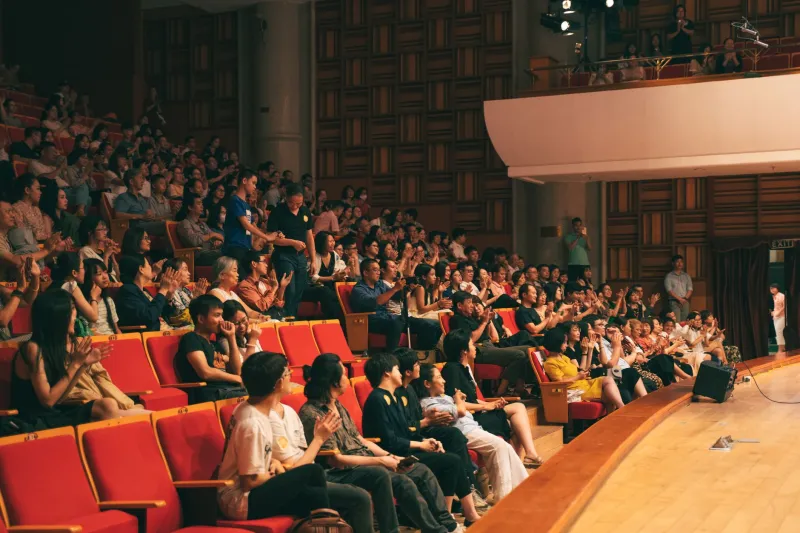
There's a venue size that the middle-lane performer has learned to love: the room that holds between 100 and 200 people. It's big enough to generate real ticket revenue—a sold-out 150-seat room at $20 a ticket is $3,000 before merchandise—and small enough to feel like an event rather than a concert. The energy is good. The artist can actually see the audience. The intimacy that makes spoken word work is intact.
These artists aren't trying to scale up to 1,000-seat venues. They're trying to sell out the same 150-seat room every three months in every city on their circuit. That's a repeatable, manageable business. And unlike the performer chasing a festival slot, they're not dependent on a booking committee's taste or a sponsor's budget.
They also understand that a loyal 150 beats a distracted 500 every single time. The audiences who show up to a mid-sized room for a performer they genuinely follow are ready to spend money. They've already proven it by buying the ticket.
Subscriber Culture and the Death of the One-Night Stand
The most forward-thinking artists in this space have stopped thinking about performances as individual events and started thinking about them as touchpoints in an ongoing relationship. A Patreon isn't just a tip jar—it's a community infrastructure. A newsletter isn't just marketing—it's a direct line that doesn't depend on an algorithm deciding whether your content gets seen today.
One poet based in Atlanta, who asked not to be named because she prefers to stay under the national radar on purpose, described her model this way: "I stopped trying to go viral and started trying to go deep. My subscribers feel like they know me. When I announce a show, they're not deciding whether to come—they already decided months ago."
That kind of relationship takes time and consistency to build. It's not as exciting as a viral moment. But it doesn't disappear when the moment ends.
What the Industry Gets Wrong About Ambition
The spoken word world, like most corners of the arts, has a tendency to conflate ambition with scale. Bigger shows. Bigger audiences. Bigger deals. But ambition can also mean building something that lasts, something that pays you reliably, something that doesn't require you to reinvent yourself every eighteen months to stay relevant to an algorithm.
The artists in the middle lane aren't lacking ambition. They've just aimed it somewhere different—at depth instead of width, at loyalty instead of reach, at a career that can survive a bad year without collapsing.
The spoken word scene is full of people who had a big moment and then had to figure out what came next. The middle-lane artists are the ones who skipped the big moment and went straight to the next. It turns out that's not the consolation prize. For a lot of them, it's the whole point.